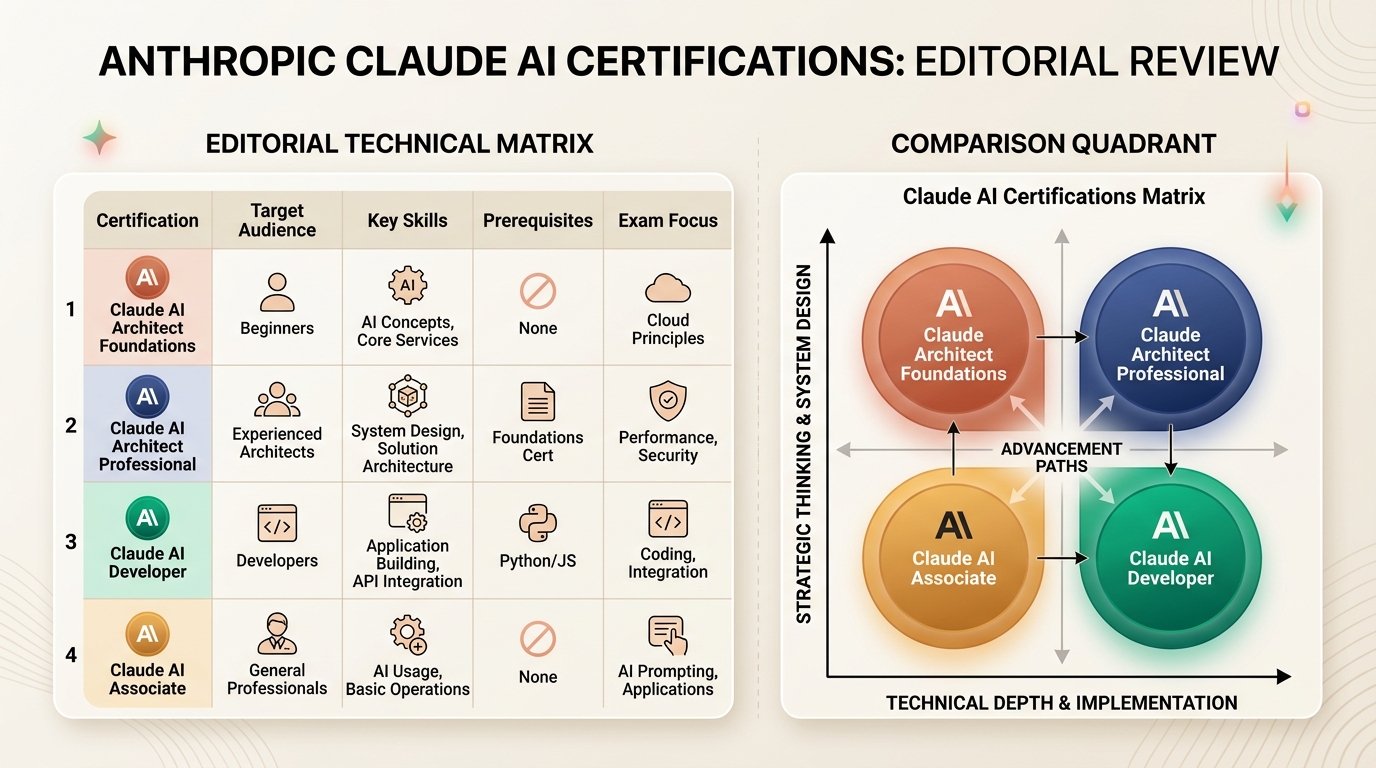
Anthropic runs four certifications through Pearson VUE — and the similar names (CCA-F, CCAR-P, CCDV-F, CCAO-F) confuse people even after they've decided to get certified. The official list is on Pearson VUE's Anthropic certification page. This article settles the choice in one read.
The four certifications in one table
| Architect Foundations | Architect Professional | Developer Foundations | Associate Foundations | |
|---|---|---|---|---|
| Code | CCA-F (CCAR-F) | CCAR-P | CCDV-F | CCAO-F |
| Price | $125 | $175 | $125 | $99 |
| Items | 60 (4 of 6 scenarios) | 63 | 53 | 60 |
| Duration | 120 min | 120 min | 120 min | 120 min |
| Passing score | 720/1,000 | 720/1,000 | 720/1,000 | 720/1,000 |
| Domains | 5 | 7 | 8 | 7 |
| Validity | 12 months | 12 months | 12 months | 12 months |
| Audience | Solution architects | Senior architects / platform eng. | Engineers / developers | Non-technical professionals |
| Coding required? | Yes | Yes | Yes | No |
All four follow the same model: Pearson VUE-proctored exam, 720 passing score on a 100–1,000 scale, and a credential valid for 12 months with free on-time renewal.
Claude Certified Architect – Foundations (CCA-F)
The entry point of the architecture track. It tests whether you can make production-grade architecture decisions with Claude: multi-agent orchestration, MCP interface design, team-wide Claude Code configuration, and prompt engineering for structured output. The exam is built on 4 scenarios drawn from a bank of 6.
Domains: Agentic Architecture & Orchestration (27%), Tool Design & MCP Integration (18%), Claude Code Configuration & Workflows (20%), Prompt Engineering & Structured Output (20%), Context Management & Reliability (15%).
Take CCA-F if: you already decide how Claude-based systems are designed in production, not just how to implement them — and you're starting out on the architecture track.
👉 Full guide and practice exams for CCA-F
Claude Certified Architect – Professional (CCAR-P)
The top of the architecture track. It doesn't formally require CCA-F, but it assumes the same fluency and goes further: RAG pipeline design, evaluation and observability frameworks at scale, regulatory compliance (GDPR, HIPAA, FedRAMP), and full-lifecycle stakeholder communication. It's the most expensive ($175) and longest (63 items) of the four.
Domains: Integration (19%), Solution Design & Architecture (17%), Evaluation, Testing & Optimization (16%), Governance, Safety & Risk Management (14%), Stakeholder Communication & Lifecycle Management (14%), Claude Models, Prompting & Context Engineering (13%), Developer Productivity & Operational Enablement (7%).
Take CCAR-P if: you've already covered CCA-F (or have equivalent experience) and now own the entire lifecycle of Claude systems in an enterprise production context — not just architecture, but RAG, evaluation, governance, and stakeholders.
Claude Certified Developer – Foundations (CCDV-F)
For people who build, integrate, and ship Claude applications day to day: the API, the Claude Agent SDK, Claude Code, custom tools, and MCP servers. It has the most domains (8) of the four, and is the only one with explicit focus on debugging and configuration lifecycle (CLAUDE.md, settings.json, prompt versioning).
Domains: Applications and Integration (33.1%), Model Selection and Optimization (16.8%), Agents and Workflows (14.7%), Prompt and Context Engineering (11.0%), Tools and MCPs (10.6%), Security and Safety (8.1%), Claude Code (3.1%), Eval, Testing, and Debugging (2.6%).
Take CCDV-F if: you write code, integrate APIs, and actually implement what the architect decides.
Claude Certified Associate – Foundations (CCAO-F)
The only one of the four built for people who use Claude, not people who build on the platform. No coding or API experience required. More than half the exam (Output Evaluation 21% + Workflow Integration 16% + Governance 15%) is applied judgment: catching a hallucination before it reaches compliance, knowing when to escalate to a Developer or Architect, and keeping sensitive data out of an upload.
Domains: Output Evaluation and Validation (21%), Workflow Integration and Solution Design (16%), Governance, Risk, and Responsible Use (15%), Prompting and Task Execution (14%), Product and Model Selection (12%), Configuration and Knowledge Management (12%), Troubleshooting and Optimization (10%).
Take CCAO-F if: you use Claude for operations, marketing, project management, education, or communications work — and you don't write code.
Deciding in 3 questions
- Do you write code or integrate APIs as part of your job? No → CCAO-F. Yes → go to question 2.
- Do you decide the architecture of Claude-based systems, or implement what's already been decided? Implement → CCDV-F. Decide architecture → go to question 3.
- Are you starting out on the architecture track, or do you already own the full lifecycle (RAG, evaluation, compliance, governance) of systems in enterprise production? Starting out → CCA-F (Foundations). Own the full lifecycle → CCAR-P (Professional).
FAQ
Can I take more than one?
Yes. All four are independent — there's no mandatory prerequisite between them at registration. In practice, the most common path is CCAO-F or CCDV-F → CCA-F → CCAR-P, as architecture responsibility grows.
Do I need CCA-F before CCAR-P?
Not formally — Pearson VUE doesn't block registration. But CCAR-P assumes the fluency built by CCA-F and goes further into RAG, evaluation at scale, and governance, so most candidates take Foundations first.
Which exam is hardest?
By item count and price, CCAR-P (63 items, $175) is the most demanding. By domain count, CCDV-F (8) is the broadest. By structure, CCA-F is the only one built on full scenarios drawn from a fixed bank.
Where do I register officially?
Through the Anthropic Partner Academy, with scheduling via Pearson VUE. You'll need a corporate email registered with the Claude Partner Network.
Does aicert.study have practice exams for all four?
The full CCA-F practice exam is live now. Question banks for CCAR-P, CCDV-F, and CCAO-F are in production — the guides with all the official details are up in the meantime.